





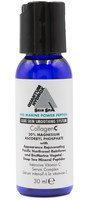
Collagenc Intensive Vitamin C Serum Complex
Ingredients overview
Highlights
Key Ingredients
Other Ingredients
Skim through
Quantum Hydrox Collagenc Intensive Vitamin C Serum ComplexIngredients explained
Good old water, aka H2O. The most common skincare ingredient of all. You can usually find it right in the very first spot of the ingredient list, meaning it’s the biggest thing out of all the stuff that makes up the product.
It’s mainly a solvent for ingredients that do not like to dissolve in oils but rather in water.
Once inside the skin, it hydrates, but not from the outside - putting pure water on the skin (hello long baths!) is drying.
One more thing: the water used in cosmetics is purified and deionized (it means that almost all of the mineral ions inside it is removed). Like this, the products can stay more stable over time.
A type of lipid that's the major (about 75%) component of all cell membranes. As for skincare, it works as an emollient and skin-identical ingredient.
It has a water-loving head with two water-hating tails and this structure gives the molecule emulsifying properties. It is also often used to create liposomes, small spheres surrounded by phospholipid bi-layer designed to carry some active ingredient and help its absorption.
A form of skincare superstar, Vitamin C. If you do not know, what the big deal about Vitamin C is, click here and read all about it, we will wait here for you.
So now you know that pure vitamin C (aka ascorbic acid, AA) is really unstable and hard to formulate so the cosmetics industry is coming up with a bunch of derivatives to solve the problem and Magnesium Ascorbyl Phosphate (or MAP) is one of them.
MAP does solve the stability problem: it's stable up to pH 7, so far so good. What is not so good is that, as the great review study about vitamin C derivatives in the Journal of Cosmetic Dermatology writes, MAP is "at very best, poorly absorbed in comparison to AA."
Moreover, derivatives not only have to be absorbed into the skin, they also have to be converted into pure AA. The good news is that in-vitro data shows that MAP does convert, but the bad news is we do not really know if the same is true on real, living human skin. Even if it does, we don't know how good the conversion rate is (but to be fair the same is true for all other derivatives).
Regarding the three magic abilities of pure vitamin C (antioxidant, collagen booster, skin brightener), there is no published data about MAP's antioxidant or photoprotection capabilities. We have better news about the other two things: in-vitro data shows that MAP can boost collagen synthesis similar to AA (though in the case of AA it's proven in-vivo) and even better, MAP is proven to work as a skin brightener in-vivo (on real people).
Bottom line: when it comes to vitamin C derivatives, MAP is definitely an option. We especially recommend it if you are after skin brightening as this seems to be the strongest point of MAP.
Butylene glycol, or let’s just call it BG, is a multi-tasking colorless, syrupy liquid. It’s a great pick for creating a nice feeling product.
BG’s main job is usually to be a solvent for the other ingredients. Other tasks include helping the product to absorb faster and deeper into the skin (penetration enhancer), making the product spread nicely over the skin (slip agent), and attracting water (humectant) into the skin.
It’s an ingredient whose safety hasn’t been questioned so far by anyone (at least not that we know about). BG is approved by Ecocert and is also used enthusiastically in natural products. BTW, it’s also a food additive.
- Green tea is one of the most researched natural ingredients
- The active parts are called polyphenols, or more precisely catechins (EGCG being the most abundant and most active catechin)
- There can be huge quality differences between green tea extracts. The good ones contain 50-90% catechins (and often make the product brown and give it a distinctive smell)
- Green tea is proven to be a great antioxidant, UV protectant, anti-inflammatory, anticarcinogenic and antimicrobial
- Because of these awesome properties green tea is a great choice for anti-aging and also for skin diseases including rosacea, acne and atopic dermatitis
If EGCG does not tell you anything, green tea sure does. We have written about green tea in excruciating details, so if you wanna become an expert in the "green tea in skincare" topic, click here and read it.
So now you know that EGCG is the magic ingredient in green tea. It's the most active polyphenol that green tea owes most of its magic properties to. It's a fantastic antioxidant, anti-inflammatory and anticarcinogenic agent. Be happy, if you spot it on the ingredient list.
This ingredient name is not according to the INCI-standard. :( What, why?!
 We don't have description for this ingredient yet.
PCA stands for Pyrrolidone Carboxylic Acid and though it might not sound like it, it is a thing that can be found naturally in our skin. The sodium salt form of PCA is an important skin-identical ingredient and great natural moisturizer that helps the skin to hold onto water and stay nicely hydrated.
A semi-essential (infants cannot synthesize it, but adults can) amino acid that is one of the primary building blocks of hair keratin and skin collagen. It's a natural moisturizing factor, a skin hydrator and might also help to speed up wound healing.
Arginine usually has a positive charge (cationic) that makes it substantive to skin and hair (those are more negatively charged surfaces) and an excellent film former. Thanks to the positive charge, it also creates a complex with AHAs (AHAs like to lose a hydrogen ion and be negatively charged, so the positive and the negative ions attract each other) that causes a "time-release AHA effect" and reduces the irritation associated with AHAs.
Beta-Glucan is a nice big molecule composed of many smaller sugar molecules (called polysaccharide). It’s in the cell walls of yeast, some mushrooms, seaweeds, and cereals.
It’s a real goodie no matter if you eat it or put it on your face. Eating it is anti-diabetic, anti-cancer, and even lowers blood cholesterol.
Putting it on your face also does a bunch of good things: it‘s shown to have intensive skin repairing & wound healing properties, it’s a mild antioxidant, a great skin soother, and moisturizer, and it even shows promising anti-aging benefits.
The manufacturer of the ingredient did a published study with 27 people and examined the effect of 0.1% beta-glucan. They found that despite the large molecular size the smaller factions of beta-glucan penetrate into the skin, even into the dermis (the middle layer of the skin where wrinkles form). After 8 weeks there was a significant reduction of wrinkle depth and height and skin roughness has also improved greatly.
Bottom line: Beta-glucan is a great ingredient, especially for sensitive or damaged skin. It soothes, moisturizes, and has some anti-aging magic properties.
We don't have description for this ingredient yet.
It’s the most commonly used version of pure vitamin E in cosmetics. You can read all about the pure form here. This one is the so-called esterified version.
According to famous dermatologist, Leslie Baumann while tocopheryl acetate is more stable and has a longer shelf life, it’s also more poorly absorbed by the skin and may not have the same awesome photoprotective effects as pure Vit E.
We don't have description for this ingredient yet.
We don't have description for this ingredient yet.
A little helper ingredient that is used to adjust the pH of the product. It also helps to keep products stay nice longer by neutralizing the metal ions in the formula (they usually come from water).
A handy helper ingredient that helps products to remain nice and stable for a longer time. It does so by neutralizing the metal ions in the formula (that usually get into there from water) that would otherwise cause some not so nice changes.
It’s pretty much the current IT-preservative. It’s safe and gentle, but even more importantly, it’s not a feared-by-everyone-mostly-without-scientific-reason paraben.
It’s not something new: it was introduced around 1950 and today it can be used up to 1% worldwide. It can be found in nature - in green tea - but the version used in cosmetics is synthetic.
Other than having a good safety profile and being quite gentle to the skin it has some other advantages too. It can be used in many types of formulations as it has great thermal stability (can be heated up to 85°C) and works on a wide range of pH levels (ph 3-10).
It’s often used together with ethylhexylglycerin as it nicely improves the preservative activity of phenoxyethanol.
It’s a handy multi-tasking ingredient that gives the skin a nice, soft feel. At the same time, it also boosts the effectiveness of other preservatives, such as the nowadays super commonly used phenoxyethanol.
The blend of these two (caprylyl glycol + phenoxyethanol) is called Optiphen, which not only helps to keep your cosmetics free from nasty things for a long time but also gives a good feel to the finished product. It's a popular duo.
A mild, natural preservative that usually comes to the formula together with its other mild preservative friends, such as Benzoic Acid and/or Dehydroacetic Acid. Btw, it's also used as a food preservative.
We don't have description for this ingredient yet.
You may also want to take a look at...
| what‑it‑does | solvent |
| what‑it‑does | skin-identical ingredient | emollient |
| what‑it‑does | skin brightening | antioxidant |
| what‑it‑does | moisturizer/humectant | solvent |
| irritancy, com. | 0, 1 |
| what‑it‑does | antioxidant | soothing |
| what‑it‑does | antioxidant | soothing |
| what‑it‑does | skin-identical ingredient | moisturizer/humectant |
| irritancy, com. | 0, 0 |
| what‑it‑does | skin-identical ingredient |
| what‑it‑does | soothing | moisturizer/humectant |
| what‑it‑does | antioxidant |
| what‑it‑does | antioxidant |
| irritancy, com. | 0, 0 |
| what‑it‑does | chelating | buffering |
| what‑it‑does | viscosity controlling |
| what‑it‑does | chelating |
| what‑it‑does | preservative |
| what‑it‑does | moisturizer/humectant | emollient |
| what‑it‑does | preservative |